
[SPACEBEL] Proba-3 Satellites Separation & ESA’s Star Surveyor Gaia

(1) SPACEBEL Involved in Successful Proba-3 Satellites Separation
We remember… On December 5th 2024, ESA’s Proba-3 pair of small satellites smoothly soared into space on a PSLV-XL launcher from the Satish Dhawan Space Centre, near Chennai, in India.
For many years, SPACEBEL has been playing a crucial role in the development of this precision formation flying mission meant to study the corona of the Sun thanks to the creation of artificial solar eclipses in orbit.
During the first weeks of their journey to the Sun, both satellites remained attached together.
On January 15th 00:00 CET, they successfully split up at a distance of 60.000 km from Earth while flying at a speed of 1 km per second.
Even is the separation relied on a well-known technology, which is routinely used when a spacecraft is released from its launcher, executing this kind of operation at spacecraft level is quite unusual as satellites are rarely physically connected during launch.
Several SPACEBEL members have contributed to this milestone along with the operations team at the ESA-ESEC site in Redu (Belgium).
Up to the real work now, i.e. the operational phase when Proba-3 will start its formation flying and sun watching mission from March onwards!
(2) ESA’s Star Surveyor Gaia Carrying SPACEBEL Know-How Is About to Bow Out
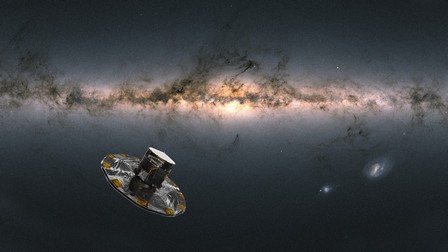
Launched in December 2013, the European Space Agency’s Gaia mission carrying state-of-the-art SPACEBEL on-board software finished its science observations on January 15th 2025.
For over a decade, Gaia has been charting the most detailed 3D map of some two billion objects throughout the Milky Way and beyond – mainly stars but also clusters, exoplanets and asteroids – considering their motions, distances, composition, colour, luminosity and temperature. The discovery of a new stellar black hole with a mass of nearly 33 times our Sun’s mass in our home galaxy is one of the mission’s major milestones.
Thanks to the results gathered by this ground-breaking satellite, astronomers are getting a very accurate insight into our galaxy’s complex history, structure and evolution and its cosmic neighbourhood.
And there is more to come as the next Gaia data releases are in full preparation: Gaia DR4, covering the mission’s first 5,5 years is expected in 2026 whereas the fifth and final major data release based on all mission data is scheduled towards the end of 2030.
SPACEBEL software has played a crucial role in the Gaia data collection as we have realised the management software of the Gaia Payload Data Handling Unit, i.e. a mass memory device storing the scientific data from seven video units that scanned our galaxy and beyond before transferring them to the ground stations.
Now that Gaia’s sky-scanning phase has come to an end, some technology tests will be performed for a short time before the spacecraft is deorbited far away from the Earth’s sphere of influence to permanently retire on March 27th 2025.